Amara Nwosu

MBCHB FRCP PhD CF SFHEA


Leave a comment

New paper: Understanding barriers and facilitators to palliative and end-of-life care research

New paper published in @BMC Palliative Care. Please read and share widely!

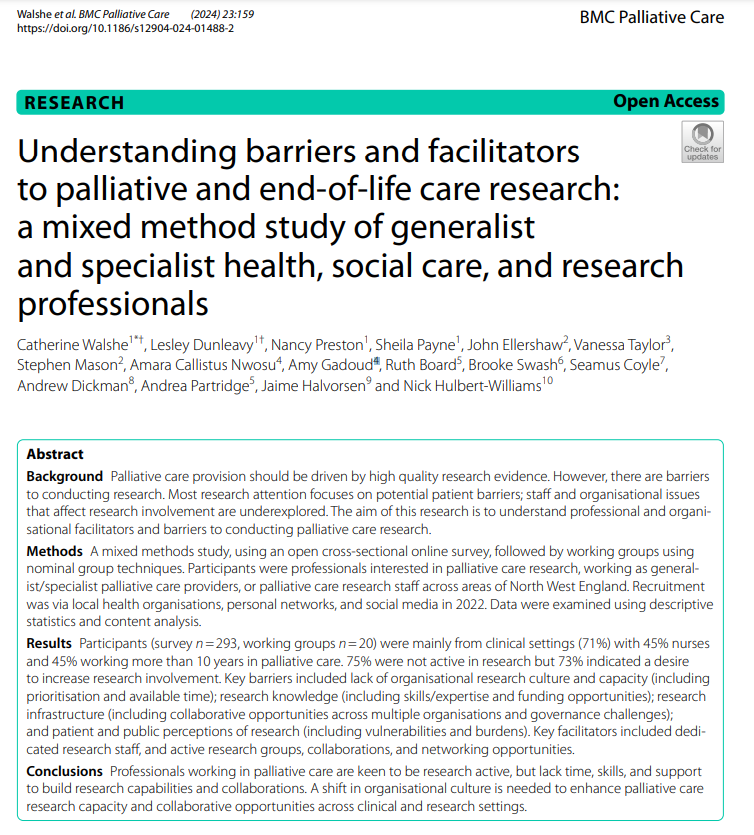
Understanding barriers and facilitators to palliative and end-of-life care research: a mixed method study of generalist and specialist health, social care, and research professionals

“Professionals working in palliative care are keen to be research active, but lack time, skills, and support to build research capabilities and collaborations. A shift in organisational culture is needed to enhance palliative care research capacity and collaborative opportunities across clinical and research settings.”

Does this describe you? How can we improve resarch capacity in palliative care?

Paper here

https://bmcpalliatcare.biomedcentral.com/articles/10.1186/s12904-024-01488-2


Leave a comment

Completion of my Churchill Fellowship report: Advancing Palliative Care: Artificial Intelligence and Design Insights from the USA and the Netherlands

I am delighted to share the report from my Churchill Fellowship which has been published online today. In 2023 I travelled to the USA and the Netherlands to research applications of artificial intelligence in palliative care.

Title

Advancing Palliative Care: Artificial Intelligence & Design Insights from the USA and the Netherlands

In addition to my written report, I have also made a YouTube video and podcast. I also include my keynote talk from 2023 Hospice UK conference.

Report

https://churchillfellowship.org/ideas-experts/ideas-library/advancing-palliative-care-ai-and-design-insights-from-the-usa-and-the-netherlands/?fbclid=IwZXh0bgNhZW0CMTAAAR0gMHiUNrGHjtO_-Mw-GO-pqj_-Q46wym3EXsHqIQ2Y4NRTkA10MLwYhX0_aem_FuWfM5HHGrrhFxULAI5krA

Video

Podcast

Keynote talk


Leave a comment

Marie Curie Hospice Liverpool win the ‘Culture for Innovation Award’ at the North West Coast Research and Innovation Awards 2023

We are delighted to announce that Marie Curie Hospice Liverpool, in partnership with the Inclusionaries Lab, has won a prestigious award at an event recognising the best innovators and researchers in health and care in Cheshire, Merseyside, Lancashire and South Cumbria.

The North West Coast Research and Innovation Awards is the only health awards event for the region, run by three NHS bodies focussed on research and innovation. The Culture for Innovation Award was presented to Marie Curie Hospice Liverpool (in partnership with the Inclusionaries Lab, University of Liverpool) in recognition of the innovative ‘Designer in Residence’ project, which involves hosting a designer (Andrew Tibbles) in Marie Hospice Liverpool for a year, to research how design methods can improve future palliative care. This project has resulted in the opening of a temporary Research Hub in the clinical area of Marie Curie Hospice Liverpool, the creation of a prototype phone installation to capture people’s experiences of hospice care, and the development of future work to explore how design can support future digital legacy research.

Marie Curie Hospice Liverpool win the CULTURE FOR INNOVATION Award. North West Coast Research and Innovation Award 2023 at The Spine Liverpool.

Left to right: Dr Laura Chapman (Medical Director and Consultant in Palliative Care, Marie Curie Hospice Liverpool), Sarah Stanley (Research Nurse, Marie Curie Hospice Liverpool), Dr Amara Nwosu (Senior Clinical Lecture in Palliative Care, Lancaster University; Honorary Consultant in Palliative Care, Liverpool University Hospitals NHS Foundation Trust; Research Lead, Marie Curie Hospice Liverpool), Andrew Tibbles (PhD Design student, the Inclusionaries LabUniversity of Liverpool), Hayley Hawkins (Deputy Head of Operations, Marie Curie Hospice Liverpool).


Commenting on the award, Dr Amara Nwosu (Senior Clinical Lecture in Palliative Care, Lancaster University; Honorary Consultant in Palliative Care, Liverpool University Hospitals NHS Foundation Trust; Research Lead, Marie Curie Hospice Liverpool) said “We are delighted to be the first palliative care winner of an award from North West Coast Research and Innovation Awards. Palliative care is an essential component to effective healthcare systems; we are proud that our innovative work to use design methods to shape palliative care services has been acknowledged through this wonderful award”.

Hosted by the Innovation AgencyClinical Research Network North West Coast (CRN NWC); and Applied Research Collaboration North West Coast (ARC NWC) the event attracted around 180 entries, of whom 36 were shortlisted in 12 categories. 

Special guest Professor Sir Stephen Powis, Medical Director of the NHS, said: “Every challenge we face is an opportunity to learn, collaborate and embrace new approaches to deliver improvements in the services we provide, for the benefit of patients, staff and the wider NHS. 

“As the NHS looks forward to its 75th birthday on 5th July, it is a good time to reflect on its journey and on the incredible research and innovation milestones that have transformed patient outcomes and that will help to build an NHS that is fit for the future.” 

The event took place at The Royal College of Physicians, The Spine in Liverpool, hosted by BBC TV North West and Breakfast presenter Roger Johnson. The full list of winners is below; to find out more about their entries, visit www.nwcawards.co.uk.  

WINNERS 2023

Culture for Innovation Award: Marie Curie Hospice Liverpool

Innovation in Workforce Development Award: Health Education England NW; Lancashire and South Cumbria NHS Foundation Trust; University of Central Lancashire

Patient Safety and Care Improvement Award: Liverpool University Hospitals NHS Foundation Trust and Innovation Agency

Research Student of the Year Award: Piotr Teodorowski, University of Liverpool

Ruth Young Award for Research Implementation: Liverpool Heart and Chest Hospital NHS Foundation Trust

Outstanding Contribution to Patient and Public Involvement Award: Lancaster University

Research Delivery Team of the Year Award: Warrington and Halton Teaching Hospitals NHS Foundation Trust

Research Collaboration of the Year Award: Marine Lake Medical Practice and Wirral University Teaching Hospital NHS Foundation Trust

Primary Care and/or Community Research Team of the Year Award: Lancaster Medical Practice

Unsung Hero: NHS 75th Anniversary Award: Sue Smith of One Wirral CIC

Tackling Health Inequalities Award: Liverpool John Moores University; University of Liverpool; Edge Hill University

Sustainability Award: Liverpool University Hospitals NHS Foundation Trust, Broadgreen University Hospital


‘Designer-in-Residence’ Programme launched at Marie Curie Hospice Liverpool

Designing the ‘Hospice of The Future

Marie Curie Hospice Liverpool are delighted to welcome two design researchers from the University of Liverpool to conduct a project to design the future of hospice care.

Andrew Tibbles (right) is a Ph.D. researcher in Design for End of life and Dr Farnaz Nickpour (left) is an Associate Professor in Design & Innovation. 

Andrew and Farnaz will be ‘Designers in Residence’ in Marie Curie Hospice Liverpool for a year, where they will study all areas of the hospice. The aim of the Designer-in-Residence programme is to co-define and co-imagine current and future hospice care as an ecosystem of people, objects, environments, technologies, practices and narratives of care. The programme has three distinct objectives and deliverables respectively:

a) co-creating a systems map of the current hospice care;

b) co-defining key values, requirements and challenges in the current system; and

c) co-imagining new value propositions in future hospice care systems.

You can find out more about the work of Dr Farnaz Nickpour and Andrew Tibbles, by visiting the website of their Design Research Lab: www.inclusionaries.com


Leave a comment

Development of ‘use-cases’ for a digital palliative care bereavement service [new study for 2022]

We are delighted that our research funding application to develop ‘use cases’ for digital palliative care bereavement service was successful. The project will be funded by Liverpool Clinical Commissioning Group and is part of the Research Capability Funding stream.

We will aim to conduct the study in 2022. The lay summary is below.

Please contact me on Twitter @amaranwosu for further information:

Lay Summary

Grief, bereavement and the need for bereavement services

Grief is a natural process, in which many people will cope with help from their friends and family. However, many people will need professional help.1-3 People who are bereaved are more likely to have problems with their mental health and wellbeing. 4-6 These problems can affect many people in society.7-9 Therefore, good bereavement care is important to ensure that people get the support they need when they are grieving.3

Challenges facing bereavement services

There are many challenges to delivering bereavement care, these include:

  • There is not enough resources to meet current demand.10 
  • Some people may not easily receive support because they live in an area where there are few services.11 
  • Some people struggle to find time to receive support during working hours due to their other commitments.
  • The COVID-19 pandemic has increased demand and has made it difficult for people to access services.3 2 
  • Palliative care need is increasing and is expected to increase by 42% in 2040, this will also increase need for bereavement support.12

Can digital bereavement services help more people receive support?

It is possible technology can be used to help more people to access bereavement support.13 However, it is important we carefully design these systems so they work properly.

In this project we will create the ‘blueprint’ needed to design a new digital bereavement serviceIn this study we will interview staff and caregivers about bereavement support, to understand what a digital bereavement service should look like. We will use this information to design the ‘blueprint’ which is needed to design a new digital bereavement support service. In computer science this ‘blueprint’ is called a ‘use-case’.14 15 We will partner with computer developers to design ‘use-cases’ which we can then use to build a digital bereavement service. After this study we will do more research to test whether the new digital bereavement service is helping more people to get the support they need.

References

1. Aoun SM, Breen LJ, Howting DA, et al. Who needs bereavement support? A population based survey of bereavement risk and support need. PloS one 2015;10(3):e0121101.

2. Pattison NA, White C, Lone NI. Bereavement in critical care: A narrative review and practice exploration of current provision of support services and future challenges. Journal of the Intensive Care Society 2020:1751143720928898.

3. Harrop E, Selman L, Farnell D, et al. 6 End of life and bereavement experiences during the COVID-19 pandemic: Interim results from a national survey of bereaved people. BMJ Supportive & Palliative Care 2021;11:A3-A3.

4. Guldin M-B, Vedsted P, Zachariae R, et al. Complicated grief and need for professional support in family caregivers of cancer patients in palliative care: a longitudinal cohort study. Supportive care in cancer 2012;20(8):1679-85.

5. Wittouck C, Van Autreve S, De Jaegere E, et al. The prevention and treatment of complicated grief: A meta-analysis. Clinical psychology review 2011;31(1):69-78.

6. Stroebe M, Schut H, Stroebe W. Health outcomes of bereavement. The Lancet 2007;370(9603):1960-73.

7. Birrell J, Corden A, Macduff C, et al. Socio-economic costs of bereavement in Scotland: main study report. 2013

8. van den Berg GJ, Lundborg P, Vikström J. The economics of grief. The Economic Journal 2017;127(604):1794-832.

9. Genevro J, Miller T. The emotional and economic costs of bereavement in health care settings. Psychologica Belgica 2010;50(1-2)

10. Harrop EJ, Goss S, Farnell DJ, et al. Support needs and barriers to accessing support: Baseline results of a mixed-methods national survey of people bereaved during the COVID-19 pandemic. medRxiv 2021

11. Wakefield D, Fleming E, Howorth K, et al. Inequalities in awareness and availability of bereavement services in north-east England. BMJ Supportive & Palliative Care 2020

12. Etkind SN, Bone AE, Gomes B, et al. How many people will need palliative care in 2040? Past trends, future projections and implications for services. BMC Medicine 2017;15(1):102. doi: 10.1186/s12916-017-0860-2

13. Morris SE, Ryan AK. Bereavement via Zoom during COVID-19. Journal of psychosocial oncology 2021:1-4.

14. Cockburn A. Writing Effective Use Cases. https://books.google.co.uk/books?id=TUZsAQAAQBAJ: Addison-Wesley 2001.15. Clausen M, Apel R, Dorchain M, et al. Use Case methodology: A progress report. Energy Informatics 2018;1(1):273-83.
15. Clausen M, Apel R, Dorchain M, et al. Use Case methodology: A progress report. Energy Informatics 2018;1(1):273-83.


Leave a comment

Technology in Palliative Care Study Consensus Meeting Completed

The Technology in Palliative Care (TIP) study consensus meeting was completed successfully on Friday 6th September, in the University of Liverpool. The TIP study (funded by Liverpool Clinical Commissing Group) aims to identify the research priorities for digital health in palliative care. The consensus meeting was attended by 12 experts, and followed two international Delphi rounds which were completed earlier this year.

The consensus meeting will be followed by a Patient and Public Engagement event (funded by Wellcome Trust, University of Liverpool Health and Life Sciences PPE scheme) which will take place in Marie Curie Hospice Liverpool on the 27th of September.

Following this event, the final report will be written and the agreed priorities will be submitted for publication in a peer reviewed journal and widely disseminated.

For more information about the TIP study please contact Dr Amara Nwosu through the contact section of this website.

Infographic vector created by studiogstock – www.freepik.com


Leave a comment

Big Data and Palliative Care


I was delighted that our letter about Big Data and palliative medicine was published in ‘Palliative Medicine’. This was in response to an editorial by Peter Tanuesputro which described how Big Data analysis of linked data has the potential to support care by indentifying patient needs. Our letter describes five challenges which need to be considered in order to make meaningful use of Big Data analysis in palliative care.

The letter is freely available in full from the link below.

Nwosu AC, Collins B, Mason S. Big Data analysis to improve care for people living with serious illness: the potential to use new emerging technology in palliative care. Palliative Medicine 2017; doi:10.1177/0269216317726250.


Leave a comment

Learning through listening: The development of the ‘SAGE Palliative Medicine & Chronic Care’ podcast

I was delighted to be invited to write a guest blog for the European Association of Palliative Care (EAPC) website, about my role in developing podcasts for ‘Palliative Medicine’ in my role Digital Editor for the journal.

The full blog post can be found here:

Learning through listening EAPC guest blog

Screen Shot 2017-08-22 at 15.16.17


How to access the ‘SAGE Palliative Medicine & Chronic Care’ podcasts

  • Subscribe to the podcasts from iTunes here.


Leave a comment

Sensor City: Connected cows and better mousetraps

This evening I had the pleasure to attend a networking event at ‘Sensor City’ Liverpool. Sensor City is a Liverpool-based technical innovation centre and University Enterprise Zone; it aims to support the creation, development, production and promotion of cutting edge sensor technologies for use in a wide range of sectors.

Home

Sensor City

The event was entitled ‘Connected cows and better mousetraps’ and detailed myriad potential  ‘use-cases’ for the application of Internet of Things (IoT) technology in industry.

http://www.sensorcity.co.uk/event/connected-cows-better-mousetraps/

The session was led by Mark Maidman, a representative from Actility (https://www.actility.com/) a company specialising in IoT devices.

As a palliative care doctor interested in technology my immediate thoughts are about the potential uses of IoT to support care of people with advanced disease and complex needs. Events like these are excellent in fostering cross-disciplinary collaboration which will hopefully lead to innovation through sharing expertise and resources.

Further information about sensor cities events can be found here:

events

Are you interested in the role of emerging technologies in facilitating supportive and palliative care for individuals and populations? If so, please free to comment and get in touch with me.


Leave a comment

Podcasts can help global discussion of palliative care

The following article has been reproduced from the University of Liverpool website:

A new study conducted by the Marie Curie Palliative Care Institute Liverpool (MCPCIL) shows the positive impact and reach podcasts can have on palliative care globally.

MCPCIL was formed in 2004 and is a partnership between the University of Liverpool, the Royal Liverpool and Broadgreen University Hospitals NHS Trust and the national charity Marie Curie, and is based with the University’s Institute of Translational Medicine.

Podcasts (downloadable online digital audio files) have the potential to facilitate communication about palliative care with researchers, policymakers and the public. Some podcasts about palliative care are available; however, this is not reflected in the academic literature.

Worldwide

The study, led by Dr Amara Nwosu, Academic Clinical Lecturer in Palliative Medicine, involved the development a podcast about palliative care, research and innovation according to internationally agreed quality indicators for medical education podcasts. Additionally, the study includes an analysis of the listenership over a 14 month period to demonstrate the reach and potential impact of the podcast.

The podcasts,were published on SoundCloud and promoted via social media. Overall 20 podcasts were developed which were listened to 3036 times (an average of 217 monthly plays) and listened to in 68 different countries. They were most popular in English-speaking areas, of which the USA, UK and Canada were most common.

The study, published in the British Medical Journal of Supportive & Palliative Care, highlights the potential usefulness for medical organisations to develop podcasts for specific purposes, such as education, lecture capture and research dissemination.

New opportunities

Dr Amara Nwosu, Academic Clinical Lecturer in Palliative Medicine, said: “Technology is increasingly being integrated into medicine to support new opportunities for the delivery of clinical practice, education and research. A palliative care podcast is a method to facilitate palliative care discussion with global audience. Podcasts offer the potential to develop educational content and promote research dissemination.

“Future work should focus on content development, quality metrics and impact analysis, as this form of digital communication is likely to increase and engage wider society.”

The full study, entitled ‘The use of podcast technology to facilitate education, communication and dissemination in palliative care: the development of the AmiPal podcast’, can be foundhere.

A podcast summary of the paper can also be found here.